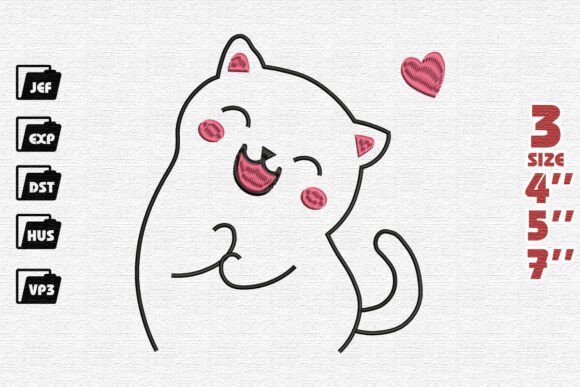
Cute Blushing Cat Embroidery
First Impression: Soft, Sweet, and Instantly Engaging
As an embroidery designer who’s prepped over 200 craft fair booths—and shipped thousands of handmade products—I’ll say it straight: Cute Blushing Cat Embroidery lands with quiet confidence. It’s not bold or loud. It’s not rustic or vintage. It’s soft-cute: gentle curves, expressive shyness, rosy cheeks that read as warmth—not blushiness—and lines that feel hand-drawn but machine-precise. That “purr-fect design to add a touch of cute” isn’t marketing fluff—it’s accurate. This is the kind of embroidery that makes shoppers pause mid-aisle, tilt their head, and smile before they even read the price tag.
Where It Shines: Craft Fair Product Realities
In a crowded handmade market, visibility and emotional resonance matter more than complexity. Here’s how Cute Blushing Cat Embroidery performs across high-turnover craft fair staples:
- Tote bag design: Ideal at 3.5–4.5 inches wide—centered on the front panel. The soft expression reads clearly from 6 feet away, and the blushing cheeks pop against natural canvas or oatmeal linen.
- Apron embroidery: Perfect above the pocket (not on the bib). Its modest scale avoids overwhelming the wearer while adding personality that customers associate with care and charm.
- Tea towel embroidery: Works best on lighter-weight cotton or linen blends. Avoid heavy terry or textured waffle weaves—the delicate cheek detail can blur. Place it in the lower corner for balance, not center-top where steam might obscure it.
- Embroidered patch: A standout. Clean edges, minimal fill, and strong silhouette make it ideal for iron-on or sew-on patches sold by the set of three. Buyers love collecting themed cat patches for jackets, bags, and denim.
- Fabric pouch & pillow cover: At 2.75–3.25 inches, it anchors the piece without dominating. On pillow covers, pair it with solid-color backing fabric—no busy prints competing with the cat’s expression.
- Caps & curved surfaces: Use caution. The shy expression relies on subtle facial proportion—distortion on a curved crown can flatten the charm. Stick to flat-front panels or structured caps with stabilizer support.
What Makes It Sell—And What Requires Care
This machine embroidery design excels in three real-world selling dimensions: clarity at glance, emotional scalability, and batch-friendly execution. Customers don’t need to study it—they get it instantly. That shy look invites connection, not analysis. And because it’s not overly detailed, it holds up across sizes: small on a keychain pouch (2”), medium on a tote (4”), large on a wall hanging (6”)—all remain recognizable and endearing.
But here’s where attention matters:
- Dense stitch areas: Rosy cheeks likely use satin or fill stitches—check your stitch density before scaling down below 2.5”. Too dense = puckering on lightweight fabrics.
- Tiny details: Eyelashes or whisker hints may vanish on dark fabric or low-thread-count cotton. Always test on your actual production fabric—not just white muslin.
- Fabric texture: Avoid heavily napped or looped towels. The soft lines of Cute Blushing Cat Embroidery need smoothness to land.
- Thread colors: Rosy cheeks demand contrast. On navy or charcoal, use pale pink or coral—not dusty rose. Muted tones disappear.
Photography, Listings, and Digital Appeal
For Etsy sellers and digital embroidery file shops, this design is a visual gift. Its balanced composition, clear negative space, and expressive focal point photograph beautifully—even on smartphone cameras. Use natural light and a clean background; no props needed. A single well-lit photo of the Cute Blushing Cat Embroidery on a cream tea towel sells more than five cluttered lifestyle shots. For printable mockups, it scales cleanly across templates—no jagged edges or pixelation when resized.
It also supports brand consistency. If your shop leans into gentle, modern handmade aesthetics—think botanicals, muted palettes, soft typography—Cute Blushing Cat Embroidery fits seamlessly. It doesn’t shout “cat lover”—it whispers “thoughtful maker.” That builds trust faster than novelty-driven designs.
Designer Notes You Can’t Skip
Before cutting your first production run, do these six things:
- Test the embroidery file on scrap fabric matching your final product—especially weight and weave.
- Check thread contrast on both light and dark fabric swatches. Adjust if rosy cheeks fade.
- Review spacing between features (eyes, cheeks, mouth)—tight gaps may merge during stitching.
- Confirm hoop size compatibility. If it requires a 5x7 hoop or larger, note that for booth setup and machine prep.
- Inspect stitch density manually—zoom in on the cheeks and inner ear. Over-stitched areas cause stiffness and visible distortion.
- Use cutaway or tear-away stabilizer appropriate for your fabric type. Lightweight stabilizer fails on tea towels; heavy stabilizer stiffens pouches.
Then—make one real mockup. Not digital. Not printed. Stitched. Hold it in your hand. Walk around your booth space with it. See how it catches light. Ask a friend to describe what they feel when they see it. That’s your truth test.
Final Thought: Charm With Craftsmanship
Cute Blushing Cat Embroidery isn’t just another cat motif. It’s a mood, a moment, a tiny emotional transaction between maker and buyer. In a craft fair setting—where attention spans are short and handmade quality is scrutinized—it delivers authenticity without effort. It elevates a simple tote bag into a giftable handmade product. It turns an apron into a conversation starter. And for Etsy sellers and small shop owners, it’s a reliable, repeatable asset—scalable across categories, gentle on production time, and strong in visual storytelling.
Just remember: its power lies in its softness—not its simplicity. Honor that. Test it. Tune it. Then let it do what it does best: make people smile, slow down, and reach for their wallet.