Cowboy Embroidery Design
First Impression: Playful, Punchy, and Instantly Recognizable
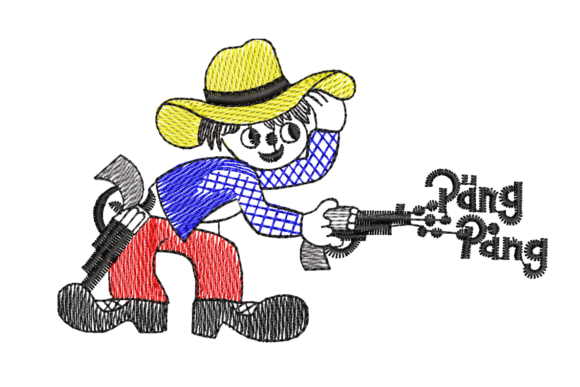
As an embroidery designer who’s prepped over 200 craft fair booths—and shipped thousands of handmade products—I opened the Cowboy Embroidery Design file expecting charm, but got *energy*. That cartoon cowboy in action paired with the bold “Päng Päng” text lands as fun, confident, and unapologetically kid-friendly—without veering into cutesy overload. It’s not rustic or vintage-western; it’s modern playful cowboy. Think Saturday morning cartoons meets Saturday market booth. That tone is gold for craft fairs: it stops parents mid-aisle, makes kids point, and signals lighthearted quality—not novelty gimmick.
Where This Design Shines on Craft Fair Products
The Cowboy Embroidery Design thrives where personality meets practicality. On a tote bag design, it reads cleanly at 4–5 inches wide—large enough to anchor the front panel without overwhelming. As apron embroidery, centered above the pocket, it adds instant character while staying legible during cooking demos. For tea towel embroidery, it works best on lighter linen or cotton weaves—avoid heavy terry or looped textures that swallow stitch definition. On caps? Yes—but only on structured front panels (not curved bill edges), and only if the design is resized to 3.25” max to maintain letter clarity in “Päng Päng.”
As an embroidered patch, this design sings. Its clean outlines and limited interior detail translate beautifully to sew-on or iron-on formats—ideal for small shop product bundles (e.g., “Cowboy Patch + Mini Tote” gift sets). On fabric pouches and pillow covers, it holds attention at arm’s length—especially when stitched with high-contrast thread colors like burnt orange on cream or navy on ecru. And for giftable handmade items? Absolutely. A set of three embroidered tea towels—one with this design, one with a cactus, one with boots—creates cohesive, shoppable variety.
What Makes It Sell—Beyond the Stitch
This isn’t just another machine embroidery design—it’s a conversation starter. At a crowded craft fair, the Cowboy Embroidery Design cuts through visual noise because it’s emotionally warm and visually bold. Customers don’t pause to decode it; they *get it* in under two seconds. That immediacy boosts booth dwell time, increases photo shares (a huge plus for Etsy seller visibility), and supports higher perceived value—even on modestly priced items like patches or pouches.
It also strengthens brand consistency across a small shop product line. Pair it with neutral backdrops, kraft packaging, and handwritten tags, and you’ve got a mini western-themed collection that feels intentional—not random. In display terms, it anchors a “Kids & Family” corner of your booth alongside bandana bibs or denim lunch sacks, making cross-selling effortless.
Photography & Online Performance
The Cowboy Embroidery Design photographs exceptionally well—especially on flat-lay mockups. Its strong silhouette and rhythmic line work pop in natural light, and “Päng Päng” gives social media captions built-in voice (“Päng Päng! Our new cowboy tote just dropped 🤠”). For Etsy listings, pair it with a printable mockup showing three real-world uses (tote, apron, patch) to reduce buyer hesitation. Avoid overly stylized backgrounds—the design’s charm is in its approachability, not pretense.
Production Reality Check: What You Must Test Before Booth Day
Don’t skip the test run. Even playful designs have production landmines. Here’s what I checked before committing to 50+ units:
- Stitch density: The cowboy’s hat brim and boot details are denser than the open areas—confirm stabilizer won’t shift or pucker on lightweight cotton.
- Small lettering: “Päng Päng” uses nonstandard characters—verify your embroidery software renders the umlaut correctly and that thread doesn’t skip on tiny arcs.
- Fabric texture: Tested on waffle-weave tea towels—lost crispness. Switched to smooth 100% cotton—clarity returned instantly.
- Dark fabric: On black canvas totes, switched from standard rayon to high-sheen polyester thread for brightness without glare.
- Hoop size & spacing: Fits comfortably in a 5x7 hoop—but double-check that cowboy’s lasso doesn’t clip the edge when digitized for larger formats.
Smart Workflow Tips for Small Business Owners
As a working embroidery designer, here’s my non-negotiable checklist before batch-producing any digital embroidery file:
- Run a test on scrap fabric matching your final product’s weight and weave.
- Compare thread colors across 3–4 fabric bases—what pops on ivory fades on oat.
- Review spacing between elements—does the cowboy’s hand clear the “Päng” letters at 4” scale?
- Confirm commercial licensing status—this is essential for selling finished product, especially on Etsy or wholesale.
- Create *one* real, photographed mockup—not digital only—before ordering materials. Your eyes catch what software previews miss.
Also: If you’re using this as part of a themed collection, treat the Cowboy Embroidery Design as your anchor motif—not your only motif. Repeat it once per item, keep supporting elements simple (e.g., single-line cacti, star accents), and let its energy carry the story. Overloading kills handmade charm.
Final Thought: Why This Design Belongs in Your Booth Rotation
The Cowboy Embroidery Design isn’t just another machine embroidery design. It’s a tested, booth-ready asset—balanced in scale, expressive in voice, and forgiving in execution. It converts lookers into buyers because it feels joyful, intentional, and authentically handmade. For craft fair sellers juggling time, thread, and table space, that’s rare. Use it where clarity and charisma matter most: on your hero tote, your signature apron, your best-selling patch. Then watch customers smile, snap photos, and reach for their wallets—before you even say a word.