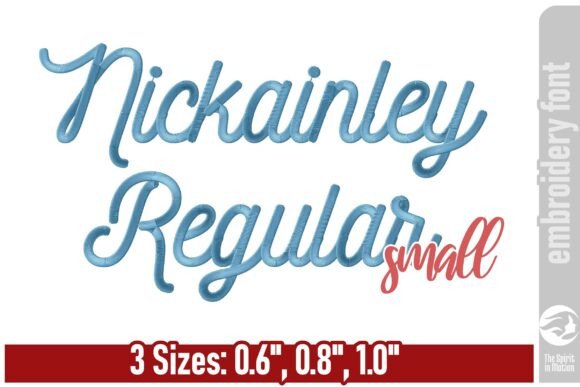
Nickainley Monoline Embroidery Font - S
First Impression: Modern, Minimal, and Made for Meaning
As an embroidery designer who’s stitched over 300 craft fair booths—from Portland pop-ups to Nashville holiday markets—I know what catches a customer’s eye in under three seconds. Nickainley Monoline Embroidery Font - S delivers that instantly: clean, flowing, and unmistakably modern. It’s not cutesy or rustic. It’s not bold or vintage. It’s contemporary handwriting translated into stitch—smooth, confident, and effortlessly elegant. That makes it ideal for makers who want their handmade product to feel intentional, elevated, and quietly premium—not loud, not trendy, but timelessly wearable.
Where Nickainley Monoline Embroidery Font - S Shines on Craft Fair Products
This font doesn’t just look good—it sells well—when placed intentionally. On tote bag designs, Nickainley Monoline Embroidery Font - S works best centered near the top third, sized large enough to read from six feet away (think 3.5–4.5 inches tall). It reads as personal, not promotional—perfect for “Maya” or “The Cozy Corner” branding. On apron embroidery, it flows beautifully across the chest pocket or along the waistband, adding quiet sophistication without overwhelming the garment’s function.
Tea towel embroidery is where Nickainley Monoline Embroidery Font - S truly stands out. Its monoline weight holds up against kitchen linen texture, and its open spacing avoids muddiness when stitched on terry or waffle weave. Paired with a single botanical motif or minimalist line art, it transforms a $12 towel into a $28 handmade gift. For embroidered patches, this font scales down cleanly to 1.75 inches wide—ideal for iron-ons on denim jackets or market bags. Just avoid stacking more than two words; tight kerning can blur at tiny sizes.
On curved surfaces like caps, Nickainley Monoline Embroidery Font - S performs well *if* digitized with gentle curve compensation—but always test on scrap fabric first. It also elevates fabric pouches and pillow covers by lending handcrafted warmth without looking juvenile or overly ornate. As a craft fair product, it signals quality before a buyer even touches the item.
What Makes It Sell Online—and In-Person
For Etsy sellers and small shop owners, Nickainley Monoline Embroidery Font - S photographs exceptionally well. Its consistent line weight eliminates harsh shadows, and its rhythm creates natural visual flow in listing images—even on dark fabric, when paired with high-contrast thread colors like cream-on-navy or charcoal-on-oat. That clarity translates directly to printable mockups: you’ll spend less time editing and more time uploading listings.
It’s also highly repeatable for batch production. Because it’s monoline and script-based—not filled or shadowed—it stitches quickly, reduces thread breaks, and maintains consistency across 20+ identical tote bags or aprons. That means less rehooping, fewer restarts, and smoother craft fair prep. No dense fill areas mean lower stitch density, faster run times, and gentler wear on your machine.
Careful-Use Notes Every Designer Should Know
- Avoid ultra-small lettering: Below 1 inch tall, fine joins (like between “n” and “i”) may vanish—especially on textured towels or thick canvas.
- Test on dark fabric early: Monoline fonts rely on contrast. If using black thread on charcoal linen, add a lightweight tear-away stabilizer underneath to prevent shadowing.
- Curved cap surfaces demand digitizing care: The natural flow of Nickainley Monoline Embroidery Font - S can distort if not adjusted for dome tension—always request or verify curve-optimized versions.
- Don’t force it onto heavily textured surfaces: Avoid dense terry cloth or bouclé without extra stabilizer layers. The smoothness of the font gets lost in the pile.
Design Decisions That Build Booth Strength & Buyer Trust
In my booth, Nickainley Monoline Embroidery Font - S consistently draws longer dwell time. Why? Because it feels designed, not automated. Customers pause, trace the letters with their eyes, and say things like, “That looks hand-lettered.” That perception boosts perceived value—and justifies higher price points on your finished product.
It also strengthens brand consistency. Use it across your small shop product line—same font on your tea towels, patches, and pillow covers—and shoppers begin recognizing your aesthetic. That cohesion makes your booth feel curated, not cluttered. And unlike busy decorative fonts, Nickainley Monoline Embroidery Font - S leaves room for other design elements: a single sprig of lavender, a geometric corner motif, or even blank space. That breathing room invites engagement instead of overwhelm.
Practical Embroidery Designer Notes Before You Stitch
- Always test the machine embroidery design on scrap fabric—same type, same color, same stabilizer—as your final product.
- Check thread contrast in natural light *and* under your booth’s lighting. What reads clearly indoors may fade under tent fluorescents.
- Review letter spacing carefully. Some versions of Nickainley Monoline Embroidery Font - S include optional connected or spaced variants—choose based on your product’s scale and purpose.
- Confirm hoop size compatibility. Script fonts often require larger hoops (5x7" minimum) for comfortable stitching and clean letterforms.
- Inspect stitch density in the file preview—look for unnecessary underlay or overlapping runs that could cause puckering.
- Match stabilizer to fabric texture: cutaway for knits, tear-away for stable wovens, and mesh for lightweight linens.
- Create at least one real mockup—not digital—before ordering bulk fabric. See how it drapes, folds, and wears.
- Compare fabric colors side-by-side: oat, clay, slate, and ivory all interact differently with the same thread palette.
- Verify commercial licensing before selling finished products. Nickainley Monoline Embroidery Font - S is intended for commercial embroidery, but confirm usage rights apply to your sales channel (Etsy, wholesale, local markets).
Final Thought: A Font That Works as Hard as You Do
Nickainley Monoline Embroidery Font - S isn’t flashy—but it’s reliable, versatile, and deeply effective. It bridges the gap between handmade charm and modern minimalism, making it a smart investment for digital embroidery file libraries, design assets for boutique makers, and everyday sewing and embroidery workflows. Whether you’re prepping for your next craft fair, building an Etsy collection, or launching a small shop product line, this font earns its place—not as decoration, but as intention made visible, one clean stitch at a time.