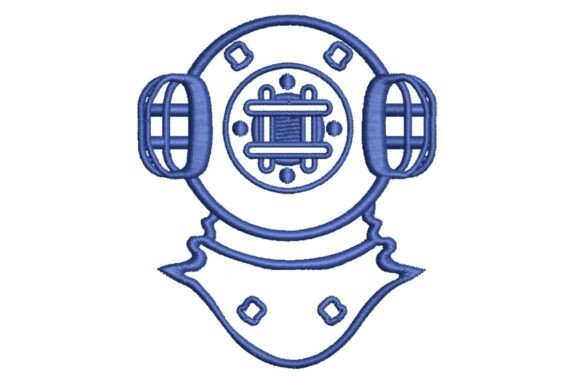
Vintage Scuba Diving Helmet Embroidery Design
First Impressions: Nostalgia, Texture, and Quiet Confidence
As an embroidery designer who’s tested hundreds of digital embroidery files for personalized gift shops and Etsy sellers, the Vintage Scuba Diving Helmet Embroidery Design landed with a soft, satisfying weight—like holding a well-worn brass diving bell in your hands. It doesn’t shout. It invites. The mood is warmly nostalgic, gently adventurous—not cartoonish or overly technical, but deeply rooted in vintage charm. That solid, textured blue helmet reads as handmade, not mass-produced; it feels like something you’d find tucked in an old maritime museum display or sketched in a grandfather’s logbook. There’s quiet elegance here, not flashiness—and that’s exactly what makes it compelling for meaningful personalized gifts.
Where This Design Truly Shines
This isn’t just another nautical motif—it’s a storytelling anchor. For baby embroidery, it’s unexpectedly perfect: imagine it stitched onto a creamy organic cotton blanket or a linen nursery pillow cover. It whispers “curiosity,” “courage,” and “gentle exploration”—far more distinctive than anchors or whales, and less gendered than traditional motifs. Grandparents love it for keepsakes; new parents appreciate its quiet sophistication.
For wedding gifts, think beyond monograms: stitch the Vintage Scuba Diving Helmet Embroidery Design onto a hand-stitched linen towel set for a couple who met on a dive trip—or onto a custom apron for the home chef who also charts ocean currents. It adds personality without overwhelming. As a small shop product, it stands out at craft fairs beside rows of generic seashells and sailboats. On a canvas tote bag? Instant conversation starter. On a kitchen towel? A wink of wit and wanderlust. And for Etsy sellers listing digital embroidery files, this design pairs beautifully with printable mockups—show it on a folded beach towel, a rolled-up blanket, or a framed pillow cover to evoke mood, not just mechanics.
Smart Pairings for Real-World Use
- Baby embroidery: Works best on structured, low-stretch fabrics—think swaddle blankets, quilted crib bumpers (safety-approved), or embroidered onesies with flat seams.
- Wedding gift: Elevates linen napkins, guest book covers, or “his & hers” robe sets—especially when paired with subtle thread colors like charcoal gray or antique gold.
- Personalized towel: Ideal for medium-weight terry or waffle-weave towels where texture supports, rather than competes with, the helmet’s dimensional feel.
- Pillow cover & blanket embroidery: Holds crisp detail on tight-weave cotton, linen blends, or brushed poly-cotton—fabrics that let the textured blue “pop” without bleeding.
- Small shop product: A natural fit for curated Beach-themed collections—but don’t limit it there. Its vintage adventure spirit crosses categories seamlessly.
Where to Proceed With Care
Like any thoughtful machine embroidery design, the Vintage Scuba Diving Helmet Embroidery Design rewards intentionality—not just enthusiasm. Avoid using it on highly stretchy baby clothes (like knit bodysuits) without advanced stabilization—the helmet’s clean curves can distort under tension. On thick, plush towels or terrycloth, confirm stitch density first: too dense, and the design may pucker or sink; too light, and the textured blue loses definition. Curved surfaces—like rounded tote bag bases or contoured pillow forms—require precise hooping and possibly repositioning mid-stitch.
Dark fabric demands attention: that “textured blue” must be verified against black, navy, or charcoal backgrounds. Does it rely on satin stitch sheen or underlay contrast? Test with your actual thread colors before committing. And if your finished product will face frequent washing—baby blankets, kitchen towels, aprons—double-check that the file includes secure under-stitching and lock stitches at critical junctions. Not all embroidery files are built for durability.
Why This Design Builds Trust—and Sales
Customers don’t buy stitches—they buy meaning, care, and confidence. The Vintage Scuba Diving Helmet Embroidery Design signals craftsmanship because it’s detailed but restrained. It tells buyers, “This wasn’t slapped on—it was chosen.” That perception lifts perceived value instantly. In product photography, it performs beautifully: the helmet’s shape creates natural negative space, making flat-lay shots clean and scroll-stopping. On Etsy listings, it encourages longer dwell time—shoppers pause to recognize the story behind the symbol.
For handmade product sellers, it deepens emotional connection. A customer ordering this for a newborn isn’t just personalizing a blanket—they’re honoring curiosity, resilience, discovery. That resonance translates into reviews, repeat orders, and word-of-mouth referrals. It transforms a simple embroidered towel into a cherished heirloom-in-the-making.
Practical Embroidery Notes You Can’t Skip
Before stitching your first customer order, treat the Vintage Scuba Diving Helmet Embroidery Design like a trusted collaborator—not just a file:
- Always run a test on scrap fabric matching your final product’s weight and texture.
- Compare thread color contrast on both light and dark fabric mockups—don’t assume the “textured blue” reads the same on ivory and slate.
- Confirm hoop size compatibility—especially if stitching on curved or narrow items like apron pockets or tote straps.
- Review stitch density: high density adds richness but risks stiffness on soft baby items; lower density may suit lightweight linens better.
- Use appropriate stabilizer—tear-away for stable wovens, cut-away for knits or stretchy blends, and water-soluble for delicate top layers.
- Inspect small details post-stitch: check helmet rivets, glass plate edges, and hose connections for clarity—not just coverage.
- Verify commercial licensing status before selling finished products—this is essential for Etsy sellers, small shop owners, and digital embroidery file resellers.
The Vintage Scuba Diving Helmet Embroidery Design isn’t just another embroidery file. It’s a quiet invitation—to explore, to remember, to personalize with purpose. When used thoughtfully, it turns everyday items into heirlooms, and casual shoppers into loyal customers. That’s the power of a well-chosen, well-executed machine embroidery design.