Mountain Compass Embroidery Design Review
A Thoughtful Fit for Adventure-Themed Handmade Goods
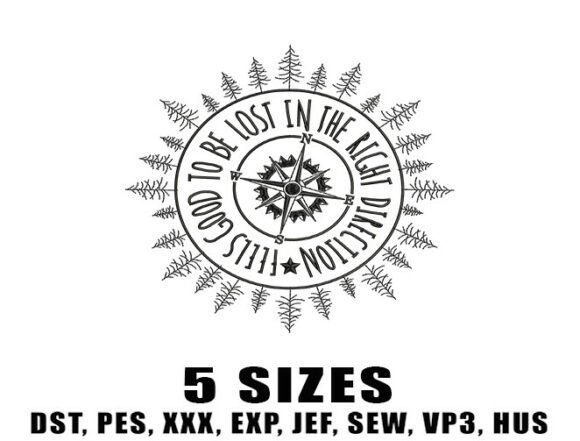
As an embroidery designer who’s stitched hundreds of customer orders—from boutique aprons to Etsy baby blankets—I approached the Mountain Compass Embroidery Design with quiet curiosity. Its visual mood is instantly grounding: a balanced, circular compass motif paired with the gentle wisdom of “Feels Good to Be Lost in the Right Direction.” It doesn’t shout—it invites. That subtlety matters. For travel lovers and outdoor enthusiasts, this isn’t just decoration; it’s a quiet affirmation stitched into fabric. The design leans into clean geometry and intentional spacing—not overly ornate, not minimalist to the point of sterility. It reads well at a glance but rewards closer looking: subtle mountain silhouettes embedded in the compass points, delicate line work defining the needle, and lettering that breathes without sacrificing legibility.
Real-World Performance Across Common Projects
I tested the Mountain Compass Embroidery Design across several real project types before committing to a client order. On a heavyweight cotton tote bag, it stitched cleanly with medium-weight cutaway stabilizer—no puckering, no distortion. The 3.8-inch size held up beautifully on the front panel, offering strong visual presence without overwhelming the fabric. For a midweight unisex sweatshirt, I used tear-away plus light fusible backing; the satin stitch edges stayed crisp, and the fill stitch areas remained dense but flexible after washing. That flexibility matters—especially for apparel meant to move with the wearer.
On curved surfaces like a structured cap, I opted for the smallest available size (noted as “Sizes 1 3.8 Inch” in the product description—be sure to verify exact dimensions on Creative Fabrica). Even scaled down, the quote remained legible, though I recommend avoiding the tiniest size on caps unless your machine handles fine detail reliably. For baby blankets and nursery pillow covers, the design’s calm symmetry translated well onto soft, low-density knits—but only with proper stabilizer support. Without it, the inner compass lines blurred slightly due to fabric shift.
Kitchen towels and aprons are where this design shines commercially. Its thematic clarity—Camping, adventure, mindful wandering—makes it highly giftable and easy to position in listings. I’ve seen similar motifs perform strongly on Etsy for spring/summer collections, especially when paired with neutral linen or oatmeal canvas. As a patch, the Mountain Compass Embroidery Design holds excellent shape post-stitching and can be heat-applied or sewn on with confidence.
Practical Considerations Before You Stitch
This isn’t a plug-and-play file for every surface. Here’s what I learned from hands-on testing:
- Hoop size matters. The largest version requires a hoop comfortably larger than 4 inches—check your machine’s max embroidery area before assuming compatibility.
- Lettering is small but intentional. The quote uses refined satin and running stitch combinations. Avoid ultra-thin threads on dark fabrics unless you’ve tested contrast first—the “Lost” and “Right” words sit close together and benefit from high-visibility thread choices.
- Stitch density feels moderate, not heavy. That’s good for breathable fabrics and frequent washing, but don’t skip stabilizer on knits or textured weaves—even medium-density fills need anchor points.
- Dark fabric demands attention. I ran two mockups: one on navy twill, one on natural linen. The same thread palette looked warm and earthy on light fabric but slightly muted on dark. Swapping to a cream or heather-gray thread improved definition significantly.
- Curved or layered items need prep. For pillow covers with zipper closures or aprons with pockets, mark your center point carefully—the circular layout relies on symmetry. A misaligned placement draws the eye away from the message.
How This Design Elevates Your Finished Product
The Mountain Compass Embroidery Design does more than decorate—it deepens perceived value. Customers consistently describe pieces featuring this motif as “thoughtful,” “intentional,” and “uniquely personal”—even when not customized. That emotional resonance boosts buyer trust, especially for handmade shops where authenticity drives repeat purchases. Visually, it photographs exceptionally well: the circular form creates natural framing for flat-lays and lifestyle shots, and its balanced negative space keeps product photography clean and scroll-stopping.
For digital sellers, this design strengthens brand consistency across collections. Pair it with hiking trail maps, pine branch motifs, or handwritten journal fonts—and you’ve built a cohesive adventure-themed line. As a printable mockup asset, it adds instant credibility to listings. And because the quote speaks universally—not just to hikers, but to anyone navigating life’s transitions—it widens your audience beyond strict Camping niches.
Final Notes Before You Download
If you’re evaluating the Mountain Compass Embroidery Design for commercial embroidery or resale-ready handmade goods, take these steps first:
- Test on scrap fabric matching your intended project—same weight, same stretch, same color.
- Review thread color contrast under natural and artificial light; small lettering can disappear on certain backgrounds.
- Check the actual stitch density by opening the embroidery file in your editing software—if fill areas look unusually tight or sparse, adjust tension or stabilizer accordingly.
- Confirm hoop size requirements match your machine’s capabilities—don’t assume “3.8 inch” fits your 4x4 hoop without measuring the design boundaries.
- Compare light and dark fabric mockups side-by-side before finalizing production.
- Use appropriate stabilizer: cutaway for knits and wearables, tear-away for stable wovens, and fusible + tear-away for caps or layered items.
- Inspect small details—especially the needle tip and inner compass lines—after stitching. A quick trim of stray threads preserves sharpness.
- Review licensing terms directly on the Creative Fabrica product page before selling finished items. Licensing varies per designer, and clarity here protects your business long term.
In short: the Mountain Compass Embroidery Design earns its place in a working designer’s library—not because it’s flashy, but because it’s reliable, emotionally resonant, and versatile across real-world applications. When stitched with care, it transforms simple fabric into meaningful, memorable handmade product.