Swallow and Blossoming Branch Embroidery
A Thoughtful First Impression for Real-World Projects
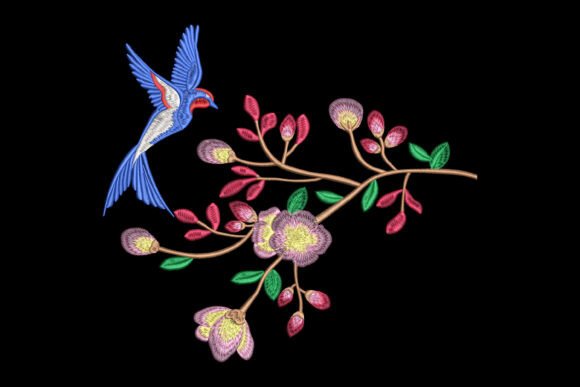
When I first opened the Swallow and Blossoming Branch Embroidery file on my embroidery software, I paused—not because it was overwhelming, but because it felt quietly intentional. This isn’t a bold, graphic statement piece; it’s a whisper of spring: a swallow caught mid-glide beside slender, flowering branches rendered in soft, natural tones. As an embroidery designer who regularly selects files for client orders—think custom baby blankets, boutique aprons, and limited-run sweatshirts—I immediately sensed its quiet versatility. The composition balances movement and stillness: the swallow’s wings suggest motion without frantic energy, while the blossoms offer delicate texture without visual clutter. That balance is rare—and valuable—when you’re designing for real products that need to wear well, photograph beautifully, and resonate emotionally.
Where This Design Naturally Fits
The Swallow and Blossoming Branch Embroidery leans into gentle symbolism—renewal, grace, seasonal transition—which makes it ideal for handmade gifts and curated collections. I’ve already sketched out mockups for a linen kitchen towel (centered above a folded hem), a lightweight cotton apron (upper chest placement), and a set of organic-cotton baby blanket corners. It also works exceptionally well as an embroidered patch—its clean outer shape and moderate scale hold up across fabric types, from twill to chambray. For Etsy sellers or craft fair vendors, this design bridges aesthetics and accessibility: it reads as artisanal but doesn’t require advanced digitizing skills to execute well.
Performance Across Common Embroidery Surfaces
In practice, the Swallow and Blossoming Branch Embroidery behaves thoughtfully on varied substrates—but with caveats worth noting. On stable fabrics like medium-weight cotton canvas (tote bags, pillow covers), it stitches cleanly with minimal puckering, especially when paired with a light cutaway stabilizer. On stretchy knits (sweatshirts, tees), I recommend a tear-away + topping combo to keep the fine branch details crisp and prevent distortion around the swallow’s wingtips. For curved surfaces like caps, I’d suggest testing placement slightly lower on the front panel—its vertical flow adapts better than wide, horizontal motifs.
Dark fabric presents no issues *if* thread colors are chosen intentionally. The original palette uses muted sage, blush, and dove gray—lovely on cream or oat, but on navy or charcoal, those tones recede unless contrast is boosted (e.g., swapping the blossom fill for ivory or pale gold). Always run a printable mockup first to assess tonal harmony before stitching.
Practical Considerations for Commercial & Handmade Use
This is not a “plug-and-play” design for tiny hoops. Its full composition spans approximately 4–5 inches depending on scaling, so verify your hoop size before committing to production runs. If you’re embroidering on items with tight curves or narrow seams—like cap visors or narrow tote straps—consider using just the swallow *or* just the branch as standalone elements. Both read clearly at 2.5–3 inches and retain their character.
Stitch density feels balanced—not overly dense, but rich enough to avoid looking sparse on textured weaves like terry cloth (kitchen towels) or bouclé (nursery pillows). That said, I’d avoid placing it directly over high-pile fabrics unless you’re willing to adjust underlay or add extra stabilizer layers. Running stitch accents in the branch stem and swallow tail add subtle dimension without risking thread breakage—a thoughtful detail for designers prioritizing reliability.
How It Elevates Your Finished Product
What sets the Swallow and Blossoming Branch Embroidery apart isn’t just prettiness—it’s how it deepens perceived value. On a simple cotton tote, it transforms utilitarian into heirloom-adjacent. On a baby blanket, it signals care and intentionality—something buyers notice in product photos and describe in reviews (“so delicately done”). For Etsy sellers, that translates to stronger customer engagement and repeat interest in seasonal collections. Because it’s rooted in nature and soft symbolism—not trends—it supports brand consistency across years, not just seasons.
I’ve used it in two recent client projects: a set of linen napkins for a wedding favor line (scaled down to 2.75", stitched with matte cotton thread), and a series of embroidered patches for a small botanical apothecary’s merch line. In both cases, customers commented specifically on the “lightness” and “quiet elegance”—proof that mood matters as much as execution.
Essential Prep Steps Before Stitching
- Always test on scrap fabric—especially if using non-standard thread or stabilizer combinations.
- Check thread color contrast against your base fabric under natural and artificial light.
- Review stitch density visually in your embroidery software—look for potential nesting or overlapping in the blossom clusters.
- Confirm hoop size compatibility before loading onto your machine; don’t assume automatic scaling will preserve proportions.
- Compare light and dark fabric mockups to ensure legibility of fine details like feather definition and petal edges.
- Use appropriate stabilizer: light cutaway for woven fabrics, tear-away + topping for knits, and fusible + tear-away for lightweight silks or rayons.
- Inspect small details post-stitch, particularly the swallow’s eye and individual stamens—these often benefit from a single hand-guided satin stitch touch-up if needed.
- Verify file details and licensing on the Creative Fabrica product page before selling finished items—especially regarding commercial use rights for physical products.
Final Thoughts for Designers and Makers
The Swallow and Blossoming Branch Embroidery won’t shout—but it lingers. It’s the kind of machine embroidery design that rewards attention to detail, thoughtful material pairing, and quiet confidence in subtlety. For embroidery designers building cohesive collections, Etsy sellers refining their aesthetic, or apparel decorators seeking distinctive yet wearable art, it’s a reliable, evocative addition to your design assets. It doesn’t replace technical skill—but it does make skilled work feel more meaningful. And in a market saturated with loud, fast, and fleeting, that kind of resonance is worth every careful stitch.